Tuesday, October 23, 2012

RELA powers reduced...but should not this about 3 million strong volunteer corps be disbanded?

A good news for migrants in Malaysia is that the long call for the abolition of RELA has finally brought some changes. With the decision to repeal  Emergency (Public Order and Prevention of Crime) Ordinance 1969 and theEssential (Ikatan RELAwan Rakyat) Regulations 1966 also had to go, and is currently being replaced by a new law, entitled "Malaysia Volunteers Corps Bill 2012", which has been passed by Parliament on about 20/4/2012, and was then expected to be gazetted within a month. (I have not managed to find any source that confirms that this has been gazetted or when, but believe that it has been)

The struggle for the abolition of RELA, or at the very least the removal of some of its powers, has been on-going, more so since the government extended its powers vide Essential (Ikatan RELAwan Rakyat) (Amendment) Regulations 2005, which also specifically targeted  "terrorist, undesirable person, illegal immigrant...". RELA was literally a dead entity, that was revived to specifically target migrants, or maybe the 'real motive' was something else, possibly a political agenda/strategy to try to regain political support for the incumbent political parties in government. After all there was already so many available avenues for 'volunteers' to join including the volunteer police force, etc... why not just encourage Malaysians to join these already existing many volunteer bodies?

In any event, the 2007 Resolution of the Malaysian Bar is enclosed, which would also give the reader an appreciation of the issue. Following this is a newspaper report and a commentary which deals with this new law...


The 61st Annual General Meeting of the Malaysian Bar held at the Grand Ballroom, Legend Hotel, Kuala Lumpur - 17 March 2007 adopted the  Resolution proposed by Charles Hector and Francis Pereira unanimously. The motion was entitled, 


Motion For The End Of The State Of Emergency And An End To Law Enforcement” By The Untrained And Armed People's Volunteer Corps ( RELA)


Whereas:-


1. On 31st August 2007, it will be 50 years since Malaysia achieved its independence and has been for over 30 years been a peaceful democratic nation.

2. It is sad that Malaysia is still in a state of Emergency as there exist today 4 Proclamation of Emergencies issued by the Yang di-Pertuan Agong that is yet to be revoked.

3. Since independence, five states of emergency have been declared under Article 150 of the Federal Constitution. The first was the only one to have been revoked. The remaining four are still in operation. The second state of emergency was proclaimed in September 1964 when the country was faced with a campaign of violence from Indonesia. Although the threat ceased within less than two years, the state of emergency was never revoked.

4. The next state of emergency was declared on 14 September 1966 following the dismissal of the Chief Minister of the state of Sarawak. No violence - or threat of violence - resulted from the crisis. The government nevertheless proclaimed an emergency, confined to Sarawak. And although the crisis was soon resolved, the state of emergency has not been revoked.

5. The fourth proclamation came on 15 May 1969 following large-scale rioting and racial violence in the capital, Kuala Lumpur, during a general election. The violence led to several hundred casualties. As a result, further elections were postponed and parts of the Constitution suspended. Normalcy was restored soon - the legislature was reconvened and normal constitutional government restored in February 1971. However, the state of emergency has yet to be revoked.

6. On 8 November 1977, the fifth Emergency, limited to the state of Kelantan, was declared following a political crisis.

7. By reason of the proclamation of emergency, numerous legislations were enacted and are still in force, including also :- 

a) Emergency (Essential Powers) Act, 1964 (30/64), today known as the Emergency (Essential Powers) Act 1979;
 b) Emergency (Public Order and Prevention of Crime) Ordinance 1969;
c) Essential (Security Cases) Regulations 1975

8. For example, Section 6 of the Emergency (Essential Powers) Act 1979, states that ""For so long as the Proclamation of Emergency referred to in the preamble to this Act remains in force, the regulations made under the Emergency (Essential Powers) Act, 1964 (30/64) (except those regulations which the Yang di-Pertuan Agong may by notification in the Gazette declare not to be in force) shall be in force and shall have effect as if they have been made under this Act; and the regulations may be amended, modified or repealed as if they have been made under this Act.". [The proclamation of emergency referred to in this Act was the proclamation issued on 15 May 1969.]

9. The Ikatan Relawan Rakyat or better known as RELA (a People's Volunteer Corps) came into being by virtue of Essential (Ikatan RELAwan Rakyat) Regulations 1966 [P.U. 33/1966], under Emergency (Essential Powers) Act, 1964 (30/64), and continue to be in force by virtue of Section 6 of the Emergency (Essential Powers) Act 1979.

10. By virtue of the Essential (Ikatan RELAwan Rakyat) (Amendment) Regulations 2005, which came into operation on 1 February 2005, the powers of the Rela, have been dangerously over-extended giving RELA personnel the right to bear and use firearms, stop, search and demand documents, arrest without a warrant, and enter premises without a warrant. and all these powers can be exercised the RELA personnel has reasonable belief that any person is a terrorist, undesirable person, illegal immigrant or an occupier. Illegal immigrant and occupier (which would be Malaysians usually) was added on by this 2005 amendment.

11. These not-professionally trained volunteers has also now been accorded protection by the new amendments whereby it is stated that "...The Public Authorities Protection Act 1948 shall apply to any action, suit, prosecution or proceedings against the Ketua Pengarah Ikatan RELAwan Rakyat, Timbalan Ketua Pengarah Ikatan RELAwan Rakyat or any member of the Ikatan RELAwan Rakyat in respect of any act, neglect or default done or committed by him in good faith or any omission omitted by him in good faith, in such capacity."

12. Noting also that there has been numerous complaints that have surfaced in the media about the RELA not just from migrants but also Malaysians ranging from torture, gangster-like behavior, damage to property, wrongful arrest and detention and even the causing of deaths.

13. Its was reported that RELA arrested a total of 17,700 people believed to be illegal immigrants and screened 94,010 people up to September 2006, and that means 94,010 people (or 76,310) with proper documentations were subjected to unnecessary harassment and their right to a remedy in law is difficult. Of the people arrested, recent reports in the media indicate that many may even not be "illegal" or "undocumented" migrants at all.

- "...six foreign workers, all with legal travel and work documents, were whisked out of their quarters in a resort in Cherating in the wee hours of the morning on Dec 28 last year when RELA members "literally broke into their chalet and ordered them out." (The Star, January 12, 2007)."

- "...a team of 30 to 40 RELA members (half not in uniforms) turned up to look for foreign workers, assaulted some and allegedly stole cash and valuables during the raid. The companies, who lodged police reports, said that all the workers had legal work permits....."(The Star, December 4, 2006)

- "22 workers of an IT company were beaten and made to do a 50m "duck-walk" at Section 30 in Shah Alam..." (The Star, February 16, 2006)


- Residents of about 10 households in Taman Anggerik, Cheras, Kuala Lumpur, complained that RELA personnel crashed into their homes after breaking door locks and smashing gates, and told them that they [RELA] were looking for illegal workers. The residents said the RELA personnel acted like gangsters and showed them no respect. When they asked the RELA personnel to explain why they crashed into their homes, they were told "we are the law." Cash totaling RM3,756 in a drawer was subsequently found missing. (The Star, October 17, 2006)


14. There have also been report of beatings and even deaths caused by RELA volunteers. As an example, in early 2006 it was reported that Ahmad Apik, 35, and Edy Sathurrohman, 26, both Indonesians, lost their lives, and they each left behind a wife and 2 young children. (Star, January 23, 2006).


15. The policy and practice of paying members of the People's Volunteer Corps (RELA) RM80-00 for each undocumented migrant must be stopped (The Star, January 23, 2006). Even MCA Public Services and Complaints Department head Datuk Michael Chong claimed that the reward offered had made RELA volunteers desperate to nab as many illegals as possible. (The Star January 23, 2006)


15. Malaysia is a developed country and professionally trained enforcement personnel should be used for law enforcement, and the use of volunteers like the RELA must end.


16. Some migrants may be undocumented, but they are still human beings and deserved to be treated humanely and should be accorded equal protection under the law.


17. Malaysia, a party to the April 1999 BANGKOK DECLARATION ON IRREGULAR MIGRATION, which clearly states "Irregular [undocumented] migrants should be granted humanitarian treatment, including appropriate health and other services, while the cases of irregular migration are being handled, according to law. Any unfair treatment toward them should be avoided" must adhere to its commitments.


18. New laws can always be enacted by a parliament in times of peace if needed.


IT IS HEREBY RESOLVED:-


a) That we, the Malaysian Bar, call upon the Yang Di-Pertuan Agung to revoke all existing Proclamations of Emergency in Malaysia;


b) That we, the Malaysian Bar call for the repeal all legislations and Acts that were enacted and continue to be in force by reason of the now existing unrevoked Proclamations of Emergency;


c) That we, the Malaysian Bar reiterate our call for the repeal of Emergency (Public Order and Prevention of Crime) Ordinance 1969 and the Essential (Security Cases) Regulations 1975;


d) That we, the Malaysian Bar specifically call for the repeal of the Emergency (Essential Powers) Act 1979 and all Regulations and Rules made thereunder, in particular Essential (Ikatan RELAwan Rakyat) Regulations 1966 [P.U. 33/1966], as amended by the Essential (Ikatan RELAwan Rakyat) (Amendment) Regulations 2005;


e) That we, the Malaysian Bar call for the employment and usage of only properly trained professional law enforcement personnel in Malaysia;


f) That we, the Malaysian Bar urge that inquests be conducted for Ahmad Apik, Edy Sathurrohman and for the other persons who have died as result of alleged RELA actions;


g) That we, the Malaysian Bar urge that all persons including undocumented migrants and/or refugees be treated humanely and accorded equal protection of the law;


h) That we, the Malaysian Bar call on the Malaysian government to immediately ratify the International Convention on the Protection of the Rights of All Migrant Workers and Members of their Families;


i) That we, the Malaysian Bar call on the Malaysian government to immediately ratify the Convention against Torture and Other Cruel, Inhuman or Degrading Treatment or Punishment.


The motion was unanimously carried.
.

****
 Source: Charles Hector Blog
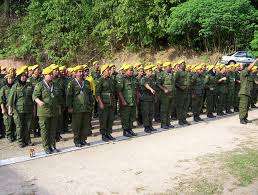
 2,924,065 RELA , about 90,000 armed forces, about 90,000 - 100,000 police...

THE powers of the People's Volunteer Corps (Rela) will be outlined in a new law which comes into effect next month. The new Act is aimed at preventing the abuse of power and impersonation of Rela members. Under the new law, which also sets the enrolment age for Rela members at 18 and limits their tenure to five years, they will no longer have the power to detain, arrest or carry firearms. 

PETALING JAYA: A new law to refine the powers of the People's Volunteer Corps (Rela) comes into effect next month with strict measures to curb misuse of authority and impersonation of its members.

Under the Malaysia Volunteers Corps Bill 2012 passed in Parliament on April 20 and expected to be gazetted next month, Rela members would no longer have the power to make arrests or carry firearms.

Anyone found guilty of impersonating a Rela member can be jailed up to three years, fined a maximum of RM5,000 or both.

The law also requires those who are no longer members to return their uniforms and certificate of appointment within 14 days of leaving the corps.

Previously, it was not an offence for them to keep their uniforms even after resigning from the agency.

“Those who fail to return the uniforms and certificate after leaving can now be taken to court,” said Deputy Home Minister Datuk Lee Chee Leong, adding that the maximum penalty for doing so would also be a prison term of three years, a fine of RM5,000 or both.

The new law also limits the period of enrolment for Rela members to five years, after which, the status of membership has to be renewed by an authorised officer.

Those below the age of 18 would also have their membership revoked under the increased age requirement when the Malaysia Volunteers Corps Act 2012 comes into force from June 22. The existing enrolment age for Rela members is 16 for girls and 17 for boys.

As of March 31, the total number of volunteers in the corps stood at 2,924,065.

Lee said the new law was expected to curb crime cases involving the impersonation of Rela members.

In March last year, police arrested two men who robbed and raped a woman after claiming to be police officers.

Two of their accomplices, including a Rela member who had lent his handcuffs to the duo, were held.

In 2006, robbers masquerading as Rela members drove off with RM47mil worth of microchips from the air cargo complex in Penang.

MCA Public Complaints and Services Department head Datuk Seri Michael Chong, who is also an honorary Rela member, welcomed the move to limit the membership to five years saying it would facilitate the management of members.

However, he said making Rela members return their uniforms would not be effective in addressing impersonation.

“If people want to misuse the uniform, they can easily buy it at shops or even online,” he said yesterday.

Chong said there were numerous shops selling uniforms and paraphernalia of all enforcement agencies, complete with their rank.

“This can only be addressed through strict enforcement on the sale of these uniforms,” he said.

Malaysian Crime Prevention Foundation chairman Tan Sri Lee Lam Thye said there was no reason for former members to hold on to their uniforms.

“We don't want to see people who are no longer Rela members misusing the uniforms to carry out or enforce laws,” he said.

Rela director-general Datuk Mustafa Ibrahim said the Home Minister would be making an official announcement on the Bill and several other laws passed recently.

Datuk Seri Hishammuddin Hussein had earlier said in Parliament that the Government had taken the public's views into consideration when drafting the Bill. - Star, 28/5/2012, New law refines Rela powers


Volunteer corps still Rela-vant?

QUESTION TIME By P. GUNASEGARAM

The time has to come to ask whether the three million strong Rela is still relevant to our times and if it should be substantially scaled down.
ONE of the most amazing things about the People’s Volunteer Corps, or Rela, is simply its size – almost three million strong, that’s more than one for every 10 men, women and children who live in Malaysia and may be about the population of core Kuala Lumpur!
In comparison, Armed Forces personnel in Malaysia account for a mere 90,000 while the police account for a like number compared with the 2.94 million Rela members as at March 31, according to news reports.
That means Rela members outnumber Armed Forces personnel by more than 30 to one and both Armed Forces and the police personnel by more than 15 to one.
The circumstances under which it was formed are somewhat vague and why its size increased to become so large is puzzling. It was set up in 1972 under the Emergency Act 1964.
The rationale apparently was after the May 1969 racial riots, they were needed to help the police preserve and maintain national peace and security. But it was some three years after the riots.
In 2005, Rela members had their roles substantially expanded. The amendment of the Essential (Ikatan Relawan Rakyat) Regulations in 2005 expanded Rela’s powers to include the right to bear and use firearms, stop, search and demand documents, arrest without a warrant, and enter premises without a warrant.
These powers can be exercised if Rela members have reasonable belief that any person is a terrorist, undesirable person, illegal immigrant or an occupier. Under the Public Authorities Protection Act 1948, Rela officers are immune from prosecution in relation to their conduct.
Subsequently, there were many reports and allegations about Rela members exceeding their authority, including a recent case where a suspected robber was beaten to death in a condominium.
Reports also cited Rela members as having been involved in crime, while others have impersonated Rela officers to commit crimes.
It was this that probably prompted the Government to revise the laws to restrict the powers of Rela members. It was reported that under the Malaysia Volunteers Corp Bill 2012, passed in Parliament on April 12 and expected to be gazetted next month, Rela members will no longer have the power to carry firearms or make arrests.
Impersonating a Rela officer becomes a crime which is punishable with a fine and a jail sentence of up to three years, while the law requires officers to return their uniforms and certificates of appointment within 14 days of leaving the corp.
These are welcome moves by the Government, but there is also a need to severely restrict and curtail the power of Rela lest it becomes a law unto itself. With its membership outnumbering police and Armed Forces personnel by 15 to one, that is an overriding concern that the Government must address.
To have nearly three million citizens in a volunteer force which has access to arms is clearly undesirable and it is now necessary to ensure that arms held by Rela members are returned according to set procedures so that there is no chance whatsoever of them being misused.
The other factor that needs to be raised is costs. How much does it take to train three million people in the use of firearms and law and order maintenance?
The question that is crying out to be asked is why not use this money to recruit and train full-time policemen who can then be deployed on the streets to fight crime on a daily basis and who will be fully and professionally trained in the use of firearms, the law and crime-fighting?
It may be easily possible to increase the size of the force by, say, 50% and give police personnel more benefits, too.
If it is the intention of the Government to bring a large section of the public into the area of law enforcement, civil defence and as reserve force to protect the country from external threats, then the best way to do that is to go for national service so that all sections of the public are represented in the defence corp.
Otherwise, it would be better for the Government to go the full distance in terms of reforming Rela and make it a much smaller auxiliary force which will merely supplement the police in terms of non-force duties such as traffic control at events and so on.
That will mean a substantial scaling back of Rela so that its size is no more than the size of the police and armed forces combined and its members reflect the population composition of the country.
The first steps have been taken no doubt, but it would be better if reform of Rela went the whole way.
> Independent consultant and writer P. Gunasegaram detests half measures. If something is worth changing, it is worth changing well. -Star, 30/5/2012, Volunteer corps still Rela-vant?

Sunday, October 21, 2012

AEPF says no to 'outsourcing' and short-term contracts

aepf9

9th Asia-Europe People’s Forum

What was interesting was the outcome of the workshop entitled "Combating Erosion of Worker and Trade Union Rights'', which was attended by about 80-100 participants, who did at the end of the 3 1/2 hour program on the 18th afternoon come up with recommendations, all of which were discussed and adopted unanimously. (See below)


Pranom Somwong, with Tian Chua(left)

Charles Hector making his presentation

Trade Unionist Mohd Roszeli (left) and Charles Hector

This workshop, "Combating Erosion of Worker and Trade Union Rights'' was organized by Workers Hub For Change(WH4C), Network of Action for Migrants in Malaysia (NAMM), MAP Foundation, Mekong Migration Network (MMN), Clean Clothes Campaign(CCC), GoodElectronics Network and Asia Pacific Forum  On Women Law and Development(APWLD)

Some of workshop participants


The call was for the abolition of outsourcing [i.e. the contractor for labour system], and short-term employment contract..
Regular employment with security of tenure until retirement
 
2-party employment relationships between principals or owners of workplaces as employers, and workers that work in the said workplaces as employees of the said principals and owners. 
  

9th Asia-Europe People’s Forum

aepf9
“People’s Solidarity against Poverty and for Sustainable Development: Challenging Unjust and Unequal Development, Building States of Citizens for Citizens”
Vientiane, Laos, 16-19 October, 2012


Conclusions/Recommendations from the participants of the Combating Erosion of Worker and Trade Union Rights Workshop, that took place at 2pm, 18/10/2012

A. Employment and Employment Relationship


1. Ensure that workers have the right to regular employment with security of tenure until retirement.


2. Abolish short-term or fixed duration employment contracts, and if still needed in exceptional situation should be limited in its use.


3. Ensure 2-party employment relationships between principals or owners of workplaces as employers, and workers that work in the said workplaces as employees of the said principals and owners.


4. Labour suppliers, contractors for labour or labour outsourcing companies should never be employers of workers.


5. Abolish manpower/labour outsourcing and all forms of triangular employment relationships/ arrangements.


B. Worker Rights & Access To Justice

1. Ensure that all worker rights are respected, including rights of access to avenues of justice, social security, healthcare, compliance with occupational health and safety standards and decent work. 
Reiko Harima of MMN

2. Migrant workers shall be allowed to work and stay legally until their complaints and claims are finally adjudicated and settled.


3. All workers, irrespective of their nationality or legal status, shall have the right to labour rights, including a right to form and/or join trade unions and collective bargaining, consistent with the international core labour standards.


C. Recommendation about UN/Regional Standards and Instruments 

 
1. In cases of rights abuse, human rights defenders, including CSR/TNC compliance monitoring bodies, should issue alerts, lobby companies and governments, raise awareness among the general population and support workers who want to fight for their rights.


2. Trade unions and CSR/TNC monitoring bodies should inform the workers of codes of conduct of companies and their supply chain, as well as relevant government policies.


3. Trade unions and CSR/TNC monitoring bodies should lobby the governments to ensure that trade agreements include guarantees for labour conditions and rights of workersใ


4. CSOs in countries where the production is based and where the investment is coming from to strengthen their collaboration.


5. Trade unions and CSR/ TNC monitoring bodies should connect workers and their representatives with the global movement, including AEPF. 


D. Recommendation about Trade Unions

1. When governments and/or ASEM have discussions/engagements with Investors, Trade Union must always be part of the process.

2. Trade unions must be included in law and decision making processes at the national regional and international levels.


3. Stronger collaboration between trade unions across sectors and regions is needed, and a strong transnational network of trade unions should be developed.


4. Trade unions of countries of origin and destination countries of migrant workers shall collaborate to ensure protection of the rights of migrant workers. Portable trade union membership shall be promoted.


5. Trade unions shall strengthen their role in monitoring labour law enforcement and CSR compliance.


This workshop was organized by Workers Hub For Change(WH4C), Network of Action for Migrants in Malaysia (NAMM), MAP Foundation, Mekong Migration Network (MMN), Clean Clothes Campaign(CCC), GoodElectronics Network and Asia Pacific Forum  On Women Law and Development(APWLD)

The recommendations/position of this workshop was included in the Final Statement of AEPF, that have been handed over to the relevant Minister of Laos, who has given his assurance that this statement will be handed over and hopefully considered by the leaders of the European and Asian nations that will be meeting in a few days time.

THE OBSERVATORY: Escalating harassment of HR Defenders in Malaysia

URGENT APPEAL - THE OBSERVATORY


MYS 001 / 1012 / OBS 095
Ongoing harassment /
Obstacles to freedom of association
Malaysia
October 19, 2012

The Observatory for the Protection of Human Rights Defenders, a joint programme of the International Federation for Human Rights (FIDH) and the World Organisation Against Torture (OMCT), has received new information and requests your urgent intervention in the following situation in Malaysia.

New information:

The Observatory has been informed by reliable sources of the ongoing and escalating harassment of several members of Suara Rakyat Malaysia (SUARAM).

According to the information received, between September 19 and October 4, 2012, several leaders and staff of SUARAM, including Dr. Kua Kia Soong, Director, Dr. Yeoh Seng Guan, Director, Ms. Nalini Elumalai, Executive Director, Ms. Danapakiam Savari, Finance Manager, Ms. Cynthia Gabriel, secretariat and former FIDH Vice President, Mr. Arumugam Kalimuthu, Chairman, Mr. Sivarasa Rasiah, Dr. Mohd Nasir bin Hashim, co-founders, deceased Fan Yew Teng and Charles Hector, and Ms. Sarah Devaraj, Refugee Coordinator, were served multiple notices from either or both the Companies Commission of Malaysia (CCM) and the Registrar of Society (ROS)[1] regarding inspection and investigation conducted by the two administrative bodies on SUARAM's registration, accounts and activities. 

A total of 16 notices were served by CCM and eight notices were served by ROS since July 2012.
In many instances, the CCM did not allow SUARAM sufficient time to respond to their requests. For instance, on October 2, 2012, the CCM requested SUARAM to produce within less than 24 hours an extensive list of documents related to all grant agreements and offer letters concluded with the National Endowment for Democracy (NED) and the Open Society Institute (OSI) and all payment vouchers and receipts related to campaign expenses between 2006 and 2011. SUARAM’s lawyers subsequently sent a letter to the CCM to condemn this new request as being both unreasonable and unrealistic, and constituting a clear act of harassment. Despite such short delays, SUARAM nevertheless did produce the documents requested. More generally, SUARAM complied with all orders served by CCM and ROS.

Since July 2012, SUARAM has been the target of ongoing harassment by the Malaysian authorities through investigations, public vilification and threats to charge SUARAM for alleged financial irregularities, receipt of foreign funds and non-registration as a society (see background information).

Moreover, acts of harassment have also been perpetrated by other pro-government entities. On September 28, 2012, a coalition of 30 pro-government Malaysian NGOs calling themselves Gerakan NGO Bertindak 1Malaysia reportedly requested that SUARAM be declared illegal and treated the same as other illegal entities such as Al-Arqam, the Malayan Communist Party and the human rights NGO Hindu Rights Action Force (Hindraf). In addition, in a Joint Memorandum submitted to the Prime Minister's Office on September 27, 2012, the same coalition of NGOs also called for legal actions to be taken by the Home Ministry, the Attorney General's Chambers, the Central Bank (Bank Negara), the CCM and the Inland Revenue Board against SUARAM members under their respective mandates. The coalition in particular accused SUARAM of having committed “offences against the State" and “offences against the person of the King”.

On October 4, 2012, right-wing group Jaringan Melayu Malaysia (JMM) also declared during a press conference that SUARAM had bribed Government officials to cover up information on its foreign funding.
The Observatory strongly denounces the escalating harassment of SUARAM, as well as the Malaysian Government's attempts to discredit those who receive foreign funds for their human rights work. Indeed, as recalled by the UN Special Rapporteur on Human Rights Defenders in her Commentary to the UN Declaration on Human Rights Defenders “Governments [should] allow human rights defenders, in particular NGOs, access to foreign funding as a part of international cooperation, to which civil society is entitled to the same extent as Governments. The only legitimate requirements imposed on defenders should be those in the interest of transparency”.

Such acts of harassment seem to merely aim at sanctioning and hindering SUARAM human rights activities. The Observatory therefore reiterates its call on the Malaysian authorities to put an end immediately to the continuing harassment against SUARAM and, more generally, against all human rights defenders and organisations operating in the country.

Background information[2]:

On July 3, 2012, a team of officers from the CCM attempted to serve a notice of inspection to SUARAM, but the organisation pointed out that said notice was defective and hence, invalid. An officer from the CCM subsequently informed SUARAM that the CCM team would come back at 10:30 am on the following day to serve a proper notice. On July 4, 2012, the Directors, Chairman, secretariat members and staff of SUARAM together with lawyers arrived at the SUARAM's office around 10:00 am in anticipation of the CCM’s scheduled visit. However, the team of officers arrived at 5:53 pm, a long time after the persons authorised to receive the notice had left the office.

Between July 6, 2012 and September 17, the CCM served notices of inspection to different SUARAM leaders and staff on at least five occasions, requesting them to produce information and documents related to the organisation's activities and/or summoning them to the CCM offices for interrogation.

On August 3, 2012, SUARAM received a letter from the Social Security Organisation (PERKESO), an agency under the Ministry of Human Resources, ordering them to bring a list of documents to its office on August 30. It is to be noted that the said letter stipulated a fine up to RM10,000 (approximately 2,500 Euros) or two-year imprisonment or both in case of non-compliance 

In addition, on August 3, 2012, Mr. Ismail Sabri Yaakob, Domestic Trade, Cooperatives and Consumerism Minister, stated in a press conference that SUARAM’s accounts were highly suspicious and maintained that CCM’s investigation on the human rights organisation was not politically motivated. A lawyer from the United Malays National Organisation (UMNO), the largest political party headed by the current Prime Minister Najib Razak, also suggested that SUARAM would act as a money laundering terrorist organisation and called upon Bank Negara (Central Bank) to take immediate actions against it.

On September 7, 2012, the Ministry of Foreign Affairs (Wisma Putra) expressed its intention to summon the German Embassy in Kuala Lumpur to explain the alleged channelling of funds to SUARAM for activities which purportedly show its “partiality to certain issues that have implications on Malaysia’s domestic situation”.

On September 8, 2012, Mr. Ismail Sabri Yaakob said that the CCM had identified five charges under the Companies Act 1965 that could be made against SUARAM. In addition, the Malaysian Government also announced that investigations would be undertaken by several other government agencies, including the ROS that has publicly alleged that SUARAM is not legally registered as a society.

On September 11, 2012, a meeting was held between the CCM, the ROS, the police, Bank Negara, the Malaysian Communications and Multimedia Commission, and the Home Ministry, reportedly to determine the jurisdiction and actions to be taken by the respective government agencies against SUARAM.

On September 13, 2012, former SUARAM staff’s family home was visited by officers believed to be from CCM, had enquired about matters pertaining to registration of businesses. The alleged officers obtained the staff’s mobile number from the family members upon learning that the staff was not at home.

Action requested:
 
Please write to the authorities in Malaysia, urging them to: 

i. Put an end to any kind of harassment against all SUARAM staff and leaders mentioned above and more generally against all human rights defenders in Malaysia;

ii. Ensure in all circumstances that SUARAM and its members are able to carry out their legitimate activities without any hindrance and fear of reprisals;

iii. Conform with the provisions of the UN Declaration on Human Rights Defenders, adopted by the General Assembly of the United Nations on December 9, 1998, especially its Article 1, which states that “everyone has the right, individually and in association with others, to promote and to strive for the protection and realisation of human rights and fundamental freedoms at the national and international levels”, as well as its Article 12.2, which provides that the State shall “take all necessary measures to ensure the protection by the competent authorities of everyone, individually and in association with others, against any violence, threats, retaliation, de facto or de jure adverse discrimination, pressure or any other arbitrary action as a consequence of his or her legitimate exercise of his or her rights”;

iv. Ensure in all circumstances respect for human rights and fundamental freedoms in accordance with international human rights standards and international instruments ratified by Malaysia.

Addresses:

·       Dato' Sri Mohd Najib bin Tun Abdul Razak, Prime Minister, Prime Minister’s Office Malaysia, Main Block, Perdana Putra Building, Federal Government Administrative Centre, 62502 Putrajaya, Selangor, Malaysia. Tel:  + 60 3 8888 8000, Fax: + 60 3 8888 3444, Email:ppm@pmo.gov.my

·        Dato Seri Hishammuddin Tun Hussein, Minister of Home Affairs – Security Collective responsibility, Blok D1 & D2, Kompleks D, Pusat Pentadbiran Kerajaan Persekutuan, 62546 Putrajaya, Malaysia.;Fax:  03-88891613/03-88891610, Email : webmaster@moha.gov.my

·        Tan Sri Hasmy Agam, Chairman of the Human Rights Commission of Malaysia (SUHAKAM),Tingkat 11, Menara TH Perdana, Jalan Sultan Ismail, 50250 Kuala Lumpur, 50250 Kuala Lumpur, Malaysia; Fax: + 603-26125620; Email: humanrights@suhakam.org.my

·       H.E. Mr. Mazlan Muhammad, Ambassador, Permanent Representative of Malaysia to the United Nations in Geneva, International Centre Cointrin (ICC), Bloc H (1st floor), Route de Pré-Bois 20, 1215 Geneva 15, Switzerland. Fax: +41 22 710 75 01. Email: malgeneva@kln.gov.my

·        Embassy of Malaysia in Brussels, 414 A avenue de Tervueren, 1150 Woluwe-Saint-Pierre, Belgium, Fax: + 32 2 762 50 49. Email: malbrussels@kln.gov.my

Please also write to the diplomatic missions or embassies of Malaysia in your respective countryas well as to the EU diplomatic missions or embassies in Malaysia. 

***
Paris-Geneva, October 19, 2012 

Kindly inform us of any action undertaken quoting the code of this appeal in your reply.

The Observatory, a FIDH and OMCT venture, is dedicated to the protection of Human Rights Defenders and aims to offer them concrete support in their time of need.

To contact the Observatory, call the emergency line:
·       Tel and fax FIDH + 33 (0) 1 43 55 25 18 / +33 1 43 55 18 80
·       Tel and fax OMCT + 41 (0) 22 809 49 39 / + 41 22 809 49 29


[1] Owing to restrictive provisions and wide powers of the Minister and Registrar to suspend, ban and cancel any societies deemed to be a threat to national security under the Societies Act 1966, SUARAM has, like a number of other Malaysian human rights NGOs, registered under the Registrar of Companies (ROC) since 2002.

[2] See Joint Press Statement, Asian and International Human Rights Groups Urge Government to End Harassment against SUARAM, September 17, 2012.

Monday, September 3, 2012

Human Resource Ministry responds to call for abolition of contractor for labour

Well, finally we have obtained a proper response from the Malaysian government. In June, we received a letter from the PM's office referring the matter to the Ministry of Human Resources. Note the letter dated 4/5/2012 was also sent to the Minister of Human Resources. The letter, which was sent  on behalf of the groups that issued the statement, included the following statement

93 Groups:- Abolish the ‘Contractor for Labour’ system Withdraw the 2012 amendments to Employment Act 1955.

93 - Mansuhkan Sistem ‘Contractor for Labour’ Tarikbalik pindaan 2012 kepada Akta Kerja 1955.

Letter from Prime Ministers Office on Abolish the ‘Contractor for Labour’ system Withdraw the 2012 amendments to Employment Act 1955

Now, the letter is in Bahasa Malaysia (the Malay language), and I have hurriedly done a rough translation  which is included below. Best read the letter and then look at my comments here.

Having considered the letter, it is my opinion that the reasons given for the amendments to introduce 'contractor for labour' are lame and misleading

1- Now, sub-contractors for labour specifically could not supply workers to principals - only to other contractors, who normally did specific short-term work at the workplaces of the principal. So, it was not a mere extension of term 'sub-contractor for labour' to 'contractor for labour'. The protest is that this amendment now allows the contractor for labour to supply workers to the principal without the principal becoming employer of the said workers. Private employment agencies already exist in Malaysia, and they supply workers to principals, who once accepted by the principal becomes employees of the principal, and the private employment agency is paid a fee for services provided.

2- All employers, be they owners or factories or some small contractor is already required to abide by the Employment Act, and also maintain a register of their workers. 

3 - The amendments was not so much to protect workers - but really contractors for labour (where unlike Private Employment Agencies is currently not strictly regulated and monitored by any existing specific law). The new amendments even giving these contractor for labour priority of debt which is usually accorded to workers only, usually with regard to unpaid salary, etc. Contractor for labour is given a special treatment compared to all other contractors and companies dealing with the principal - why is that? 

4 - Para 8 - look at the last few sentences. Note that even if the proposed amendments concerning 'contractor for labour' is not there, the workers would not be prejudiced. The only prejudice is to the contractor for labour who now, just like any other contractors, sub-contractors, suppliers, etc will have to claim against the principal through the civil courts. Malaysian government should be concerned with the rights of workers - not rights of these contractor for labour.

5 - So, we must continue to call for the abolition of the contractor for labour, and repeal of all those amendments concerning contractor for labour. We already have Private Employment Agencies, and this is all we need for they can very easily assist principals to find workers, and assist workers to find employers.

6 - Really, when will a worker of a contractor for labour become an employee of the said contractor. The moment the said worker starts working with the principal? Or should it not be the moment the worker signs on with the contractor for labour? When will he stop being an employee of the contractor for labour - when he is no more needed by the principal? Rightly, if it is going be the case that the worker is an employee of the contractor for labour, his employment and salary should start when he signs up with the said contractor and until his contract with the said contractor ends, not when the principal says he does not require workers anymore. It is just too complicated for the contractor for labour really does not have workplace or work for workers - best to just abolish contractors for labour.

The above are initial reactions only..


(Below is a speedy rough translation from Bahasa Malaysia[Malay Language] to English of the letter dated 23/8/2012 that was received by me on 3/9/2012 from the Ministry of Human Resources. This letter is in response to the Letter and accompanying Joint Statement that was send on 4/5/2012, which was endorsed by over 90 different Trade Unions and Civil Society Organizations. Compare with the original Malay letter for confirmation of the accuracy of the translation)

Our Reference: KSM/DP(S)1/1/02
23 August 2012
MANSUHKAN SISTEM CONTRACTOR FOR LABOUR – TARIKBALIK PINDAAN 2012 KEPADA AKTA KERJA 1955
ABOLISH CONTRACTOR FOR LABOUR SYSTEM – WITHDRAW 2012 AMENDMENTS TO EMPLOYMENT ACT 1955
I refer to your letter dated 4th May 2012 about the abovementioned matter.

2. In advance, I on behalf of the Ministry wish to record our appreciation to you for giving your viewpoints about the Employment Act (Amendment) 2012. As you would realize that the changes made are in line with the desire of the Government to implement transformation in the management of industrial relations and as such obviously the worker element in catalyzing development of the country is an important factor that much be given attention. Thus, in realizing this transformation, the Ministry is of the opinion that the said Employment Act 1955 need to be strengthened by making necessary amendments to already existing clauses after taking into consideration the views of workers and employers through a tripartite approach to ensure that the welfare of workers is given clear guarantees in labour legislations so that it is always protected.

3. As you would realize, before the Act was amended there was a pre-existing definition for sub-contractor for labour who functioned to manage workers needed by principals. What was clear was that the practice employment through this sub-contractor for labour has long been occurring and they were not registered. As a result, it caused the employment of workers through this system was not efficiently and effectively controlled. There were situations where the welfare of the workers was threatened and the employer that committed these wrongdoings were difficult to be identified and appropriate actions taken against them. As a result, based on the principle of improvement and not at for any negative reasons that these amendments were made to the definition of sub-contractor for labour changing it to contractor for labour (manpower contractor) under Section 2 Employment Act 1955 by merely adding the word ‘principal’ only. The amendment was meant to expand to expand the scope of usage so that it covers and includes the relationship between principal, contractors and sub-contractors that provide manpower. Thus, the Ministry, in good faith, brought about this new definition to control the practice of supplying workers by contractor for labour (manpower contractors) especially in the plantation sector so that it is more organized.

4. For your information, the Ministry did not intend to create simplification or the promotion of contractor for labour (manpower contractors). As such with this new definition it will ‘tighten’ all process of monitoring and enforcement by the Ministry through the Manpower Department (Labour Department). Vide this amendment it also will not provide opportunity to any party who simply want to be or with intention to be contractor for labour to do without complying with the existing labour legislations. The obligation for contractor for labour to register under section 33A with the Director General of Human Resource Department is to provide a register that will ensure workers are given appropriate protection including their welfare with regard contributions to the Employees Provident Fund (EPF/KWSP) and Social Security Organisation (SOCSO/PERKESO). This provision is important for the purpose of monitoring and inspection by the Human Resource Department and further will avoid the happening of violations/exploitations of employed workers.

5. With regard to this, Ministry would like to explain that the practice of contractor for labour (manpower contractors) is a global phenomenon and Malaysia is not exempt. Thus, the definition of contractor for labour (manpower contractors) is not a new proposal. This amendment was supported by the National Union of Plantation Workers (NUPW) because this practice of supplying workers by contractor for labour (manpower contractors) is already happening and need to be registered with the purpose of increasing transparency, enabling enforcement of laws and protecting the welfare of workers. The proposed amendments in no way reflective of the Government’s intention to create worry, erode rights and worker interests about security of tenure, jeopardize the permanency of jobs, or even avoid the status and responsibility of employers including contractor for labour (manpower contractors). The government has also no desire to create difficulty in identifying the true employer in the question of wage payments and absence of the right to unionize. In fact, the real intention of the amendments is to enable the Ministry in particular the Human Resource Ministry to identify positively the party that should be responsible for the said workers. Therefore, the belief that the Ministry is promoting employment of workers through the contractor for labour system or outsourcing is not accurate.

6. Further, the Ministry wishes to clarify that the amendment to the Employment Act 1955 came into effect on 1 April 2012, is meant to fulfill the needs and current changes by providing a more conducive environment for labour and strengthen the enforcement of labour laws. Amongst the other positive amendments which have been inserted is compulsory payment of wages of workers including domestic workers into bank accounts, maternity leave benefits to all women workers, new provisions to combat sexual harassment at the workplace which protects all workers, mandatory public holiday for Malaysia Day and others.

7. In making the amendment to labour laws, the Ministry always listens and takes into consideration views and feedback from employers and workers. This is to ensure a harmonious labour environment. As a step forward, the Ministry with the approval oif the Malaysian Trade Union Congress (MTUC) and the Malaysian Employers Federation(MEF) have set up a Committee to study the employment practice of contractors for labour. The object of this Committee which has been set up is to propose preventive steps and improvements so that there will not happen any abuse by any of the parties concerned when the said amendments start to be put into effect.

8. By taking the spirit of tripartism and caring Government on this issue, besides fulfilling the request of the NUPW that there be provisions enacted to protect the said workers as well as the request of MTUC to maintain the existing provisions, the Ministry has made an Exemption Order under section 2B of the Employment Act 1955. This exemption order is made to exempt all activities of manpower supply by any contractor for labour in all sectors, save the agricultural and plantation sector from compliance with the provisions concerning rights of contractors for labour as contained in section 31, 33A, 69 and 73 of the Employment Act 1955. This means, the new provisions concerning contractor for labour only applies to contractor for labour carrying out activities of manpower supply in the agricultural and plantation sector only. Whereas the rights of the subcontractors for labour for all the other sector is maintained as was before the Employment Act 1955 was amended. As such, if there are any claims against contractors for labour, the said workers can still make the said claims as per their capacity as employers under the Employment Act 1955 only. However, claims by contractors for labour against principals can only be made through civil courts.

9. In conclusion, in making a new policy and amendment to any labour laws, the Ministry always listens and considers any suggestions advanced by workers or employers and other dialogue partners. In connection with that, whatever decision made is only based on the interest of both parties being worker rights and employer interest which have to be balanced. It is hoped that the recent amendments to the Employment Act 1955 will get the support of all parties to ensure workers welfare is protected and to guarantee harmonious industrial relations in this country.

That’s all. Thank You

“IN SERVICE OF THE NATION”
“Innovative Workers the Movers of Transformation”

-signed-
(JACK MEREDU KO)
On behalf of the Chief Secretary of the Ministry of Human Resources

c.c. SUSK YB Minister of Human Resources